
How to Revise for A-Level Maths: A Complete Guide
How to revise A-level maths effectively: bridge the gap from GCSE, plan weekly revision across pure, statistics and mechanics, and practise exam technique.
By Mathidia Mathematics Academy editorial team · · 8 min read
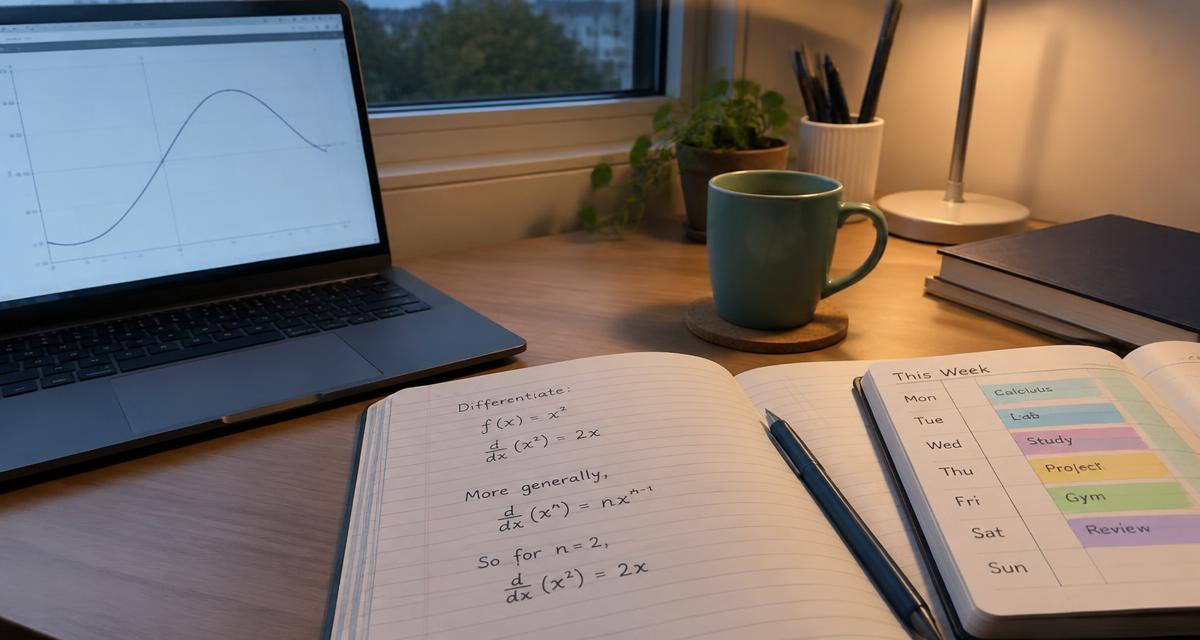
A-level maths is a significant step up from GCSE. The content moves faster, questions are longer, and you are expected to write precise, connected mathematical arguments. Revision that worked at GCSE, such as rereading notes, rarely works here.
This guide explains how to revise A-level maths so that methods become fluent, mistakes become rarer and exam papers feel manageable.
Understand the structure of the course
A-level mathematics in England covers pure mathematics, statistics and mechanics. Pure mathematics makes up the largest share and includes algebra, functions, coordinate geometry, sequences and series, trigonometry, exponentials and logarithms, differentiation, integration, numerical methods and vectors.
Most specifications assess the course through three written papers taken at the end of the course. Check your own exam board's specification so you know exactly which topics appear on which paper and which statistical data set, if any, you need to know.
Step 1: Close the gap from GCSE
Many A-level difficulties are actually GCSE algebra difficulties. Before moving on, make sure these are automatic:
- Expanding and factorising, including quadratics
- Laws of indices, including negative and fractional powers
- Surds and rationalising denominators
- Completing the square
- Solving simultaneous equations, one linear and one quadratic
A week spent strengthening these skills will save many lost marks later.
Step 2: Plan revision in weekly blocks
Spread topics across the week rather than spending a whole week on one area. Returning to a topic after a few days, known as spaced practice, strengthens long-term memory.
- Three sessions a week on pure mathematics
- One session on statistics
- One session on mechanics
- One mixed session combining questions from all three
- A short weekly review of your error log
Step 3: Use active recall, not rereading
Reading notes feels productive but gives a false sense of security. Test yourself instead.
- Close your notes and write down a method from memory.
- Attempt a question without looking at a worked solution.
- Check, then correct any errors in a different colour.
- Revisit the same question type a few days later.
Worked example: differentiating with the power rule
- Differentiate y = 3x⁴ − 5x² + 7x − 2.
- Apply d/dx(xⁿ) = nxⁿ⁻¹ to each term.
- 3x⁴ becomes 12x³; −5x² becomes −10x; 7x becomes 7; the constant −2 becomes 0.
- So dy/dx = 12x³ − 10x + 7.
Answer: dy/dx = 12x³ − 10x + 7
Step 4: Connect topics through problem-solving
A-level questions often combine several topics, for example using differentiation to find a stationary point and then integration to find an area. Practise mixed questions so you learn to recognise which tools a problem needs.
Worked example: a stationary point
- Find the stationary point of y = x² − 6x + 11.
- Differentiate: dy/dx = 2x − 6.
- Set dy/dx = 0: 2x − 6 = 0, so x = 3.
- Substitute: y = 9 − 18 + 11 = 2.
- The second derivative is 2, which is positive, so this is a minimum.
Answer: Minimum point at (3, 2)
Step 5: Practise full papers and exam technique
In the final months, sit complete papers under timed conditions. Afterwards, mark them with the official mark scheme and study how marks are awarded.
- Show every line of working; many marks are for method.
- State results you are using, such as identities or formulae.
- Give answers to the accuracy requested.
- For 'show that' questions, reach the given result exactly, without skipping steps.
- In statistics and mechanics, state assumptions and interpret answers in context.
Frequently asked questions
- How many hours a week should I revise A-level maths?
- There is no single correct figure, but regular sessions spread across the week work better than occasional long ones. Several focused sessions of 45 to 60 minutes each week, plus a weekly review, is a sustainable routine for many learners.
- Is A-level maths much harder than GCSE?
- It is a substantial step up. The content is more abstract and questions are longer and less structured. Strong GCSE algebra makes the transition much smoother.
- Can I revise A-level maths online?
- Yes. Online lessons and practice questions work well for revision, especially when they provide worked examples and immediate feedback. Combine them with past papers from your exam board.
- What is the best way to remember formulae?
- Use them repeatedly in questions rather than memorising lists. Check which formulae your exam board provides in the formula booklet and focus your memory work on those that are not given.