
How to Get a Grade 9 in GCSE Maths: Problem-Solving and Exam Strategy
What separates a grade 8 from a grade 9 in GCSE maths: unfamiliar problems, algebraic proof, precise working and exam timing, with worked examples.
By Mathidia Mathematics Academy editorial team · · 8 min read
A grade 9 is awarded to a small share of GCSE maths candidates. The learners who reach it are rarely those who know more formulas. They are the ones who can apply familiar ideas to unfamiliar problems, write clear logical arguments, and avoid the small errors that cost one or two marks at a time.
If you are already working at grade 7 or 8 on the Higher tier, this guide explains what to change in your preparation to close the final gap.
Know what grade 9 questions look like
The final questions on each Higher paper tend to combine several topics, give little guidance, and award marks for a chain of reasoning. Typical features include:
- Multi-step problems that join algebra with geometry or ratio
- Algebraic proof, such as showing an expression is always odd or a multiple of a number
- Circle theorems with reasons required for each step
- Functions, including composite and inverse functions
- Quadratic inequalities, iteration and the equation of a circle
- Vectors used to prove points lie on a straight line
Collect these questions from past papers into one place and work through them as a distinct practice set.
Method 1: Make algebra completely reliable
Almost every top-grade question depends on fluent algebra. Expanding, factorising, rearranging and working with algebraic fractions must be quick and accurate, because errors early in a long problem carry through to the end.
Worked example: algebraic proof
- Prove that the sum of three consecutive integers is always a multiple of 3.
- Let the integers be n, n + 1 and n + 2.
- Their sum is n + (n + 1) + (n + 2) = 3n + 3.
- Factorise: 3n + 3 = 3(n + 1).
- Since n + 1 is an integer, 3(n + 1) is a multiple of 3.
Answer: The sum is 3(n + 1), which is always a multiple of 3.
The final sentence matters. Proof questions often reserve a mark for a clear conclusion that links the algebra back to the statement.
Method 2: Practise unfamiliar problems deliberately
Routine practice builds speed, but grade 9 requires comfort with the unexpected. When a question looks unfamiliar, use a fixed opening routine:
- Write down what you know and what you are asked to find.
- Label the diagram or define variables.
- Ask which topic links the information to the goal.
- Try one step, even if you cannot see the full route.
Method marks are awarded along the way, so starting a problem is far better than leaving it blank.
Method 3: Give full reasons in geometry
Circle theorem and angle questions usually ask you to give reasons. Use the standard wording, for example 'the angle between a tangent and a radius is 90°' or 'angles in the same segment are equal'.
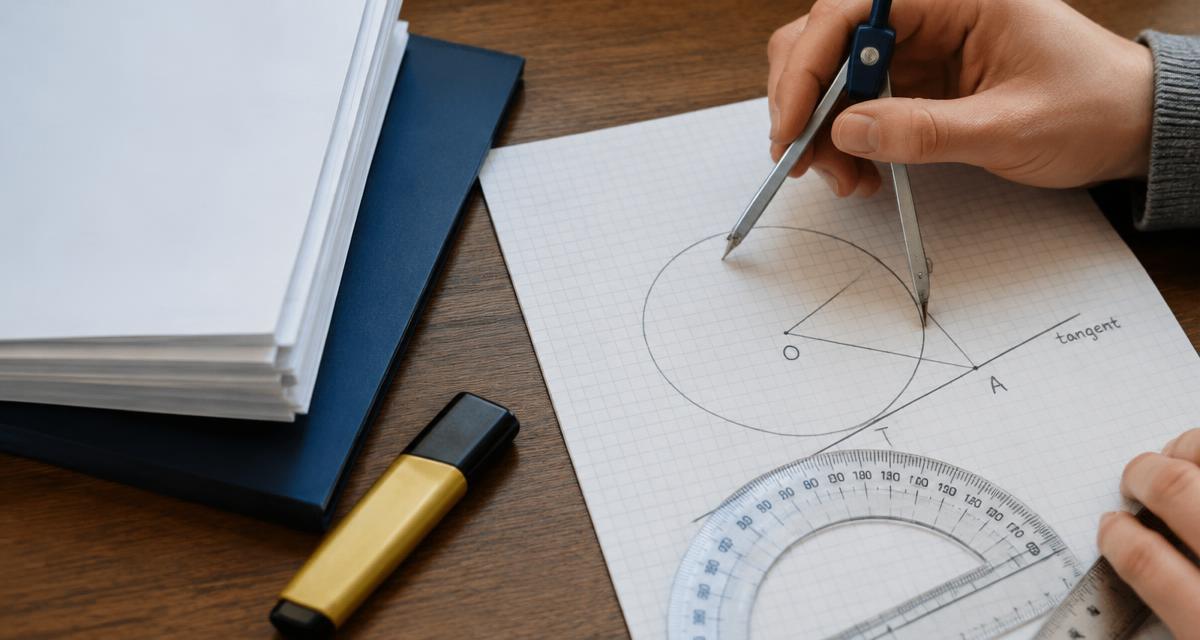
Worked example: tangent and radius
- A tangent touches a circle with centre O at point A. Point T lies on the tangent, and angle AOT is 52°. Find angle OTA.
- OA is a radius and AT is a tangent, so angle OAT = 90° (tangent meets radius at 90°).
- Angles in triangle OAT sum to 180°.
- Angle OTA = 180° − 90° − 52° = 38°.
Answer: 38°
Method 4: Remove small errors
At the top end, grades are often decided by a handful of marks. Keep an error log and look for patterns.
- Sign errors when expanding brackets with negatives
- Rounding too early in a multi-step calculation
- Missing units or giving an answer to the wrong accuracy
- Answering a different question from the one asked
- Forgetting the second solution of a quadratic
Keep full calculator values until the final step, and re-read the question before writing your final answer.
Method 5: Manage time on the paper
A useful guide is roughly one minute per mark. Move through the early questions efficiently but carefully, so you leave enough time for the final problems, which are worth more marks each.
- If you are stuck for more than two minutes, mark the question and move on.
- Return to skipped questions with a fresh view.
- Use spare time to check substitutions and re-read longer answers.
Frequently asked questions
- How many marks do you need for a grade 9 in GCSE maths?
- There is no fixed number. Grade boundaries are set each year for each exam board, so aim to secure all routine marks and as many of the final problem-solving marks as possible.
- Can you get a grade 9 on the Foundation tier?
- No. The highest grade available on the Foundation tier is 5. A grade 9 requires the Higher tier.
- Which topics matter most for a grade 9?
- Fluent algebra underpins almost everything. Beyond that, practise algebraic proof, circle theorems, functions, vectors, quadratic inequalities and multi-step problems that combine topics.
- How should I practise for grade 9 questions?
- Gather the final questions from several past papers into a dedicated set, attempt them before reading solutions, and record every mistake in an error log so you can spot patterns.