
How to Self-Study and Pass GCSE Maths: A Step-by-Step Guide
A practical plan for passing GCSE maths through self-study: find your gaps, secure the core marks, practise daily and use past papers properly.
By Mathidia Mathematics Academy editorial team · · 8 min read
Passing GCSE maths is less about talent and more about method. Most marks on a GCSE paper come from a predictable set of skills that are tested again and again: number work, algebra, ratio, geometry and data. If you can find which of these you are losing marks on and fix them in a sensible order, a pass is a realistic goal, whether you are in school, resitting, or studying on your own.
This guide sets out a five-step self-study plan. It works for the Foundation and Higher tiers, and it suits anyone who wants a clear routine rather than random revision.
Understand what a GCSE maths pass means
In England, GCSE maths is graded from 9 (highest) to 1. A grade 4 is generally described as a standard pass and a grade 5 as a strong pass. Many colleges, apprenticeships and employers ask for a grade 4 as a minimum, so it is worth checking what your next step needs.
You will usually sit three papers. One is non-calculator and two allow a calculator. The exam is offered at two tiers: Foundation, where the top available grade is 5, and Higher, which covers grades 4 to 9. If your aim is a secure grade 4 or 5, Foundation is often the safer route, because the questions focus on core skills you can master.
Grade boundaries change every year, so do not aim for a fixed number of marks. Aim instead to answer every core question confidently and to pick up method marks wherever you can.
Step 1: Find your gaps with an honest diagnostic
Before revising anything, find out where you actually stand. Sit one full past paper under timed conditions, then mark it carefully against the mark scheme. Record every lost mark against a topic name, not just a score.
- List each question you dropped marks on and its topic.
- Note whether the problem was knowledge (you did not know the method), accuracy (you made a slip) or time (you did not reach it).
- Group the topics into three columns: secure, shaky and unknown.
This list becomes your revision plan. Revising topics you already know feels productive, but the marks are hidden in the shaky and unknown columns.
Step 2: Secure the core marks first
Some topics appear on almost every paper. Securing them gives you a strong foundation before you move to harder content.
The high-frequency core
- Fractions, decimals and percentages, including percentage change
- Ratio and proportion, including sharing in a ratio
- Solving linear equations and rearranging simple formulae
- Area, perimeter and volume of common shapes
- Angles in parallel lines, triangles and polygons
- Reading and interpreting charts, averages and range
- Basic probability, including listing outcomes
Worked example: solving a linear equation
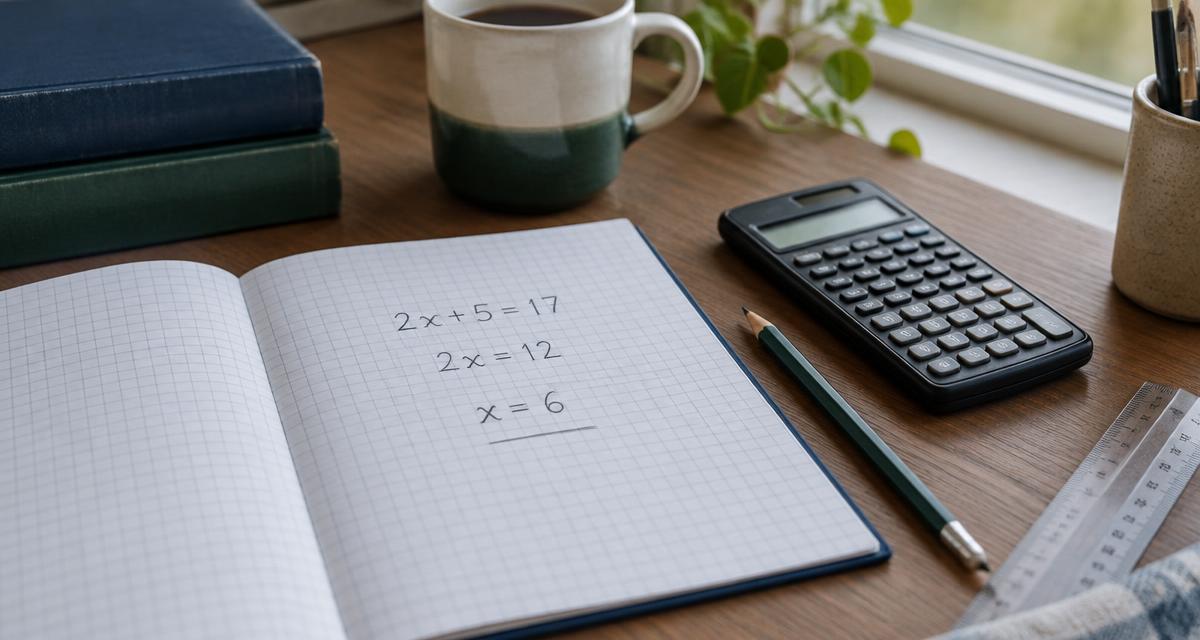
- Solve 2x + 5 = 17.
- Subtract 5 from both sides: 2x = 12.
- Divide both sides by 2: x = 6.
- Check by substituting: 2 × 6 + 5 = 17. Correct.
Answer: x = 6
Notice the final check. Substituting your answer back takes ten seconds and catches many careless errors.
Step 3: Practise a little every day
Short daily practice beats long weekend sessions. Twenty to thirty minutes a day, five days a week, builds the fluency that exam conditions demand.
- Warm up with five quick questions from topics you already know.
- Spend the main block on one shaky topic: read a worked example, then try questions on your own.
- Finish by writing down one mistake you made and why.
Try each question before checking the answer. Looking at the solution first feels efficient, but it trains recognition, not recall. In the exam, nobody shows you the first step.
Worked example: percentage change
- A jacket's price rises from £40 to £46. Find the percentage increase.
- Find the change: £46 − £40 = £6.
- Divide by the original amount: 6 ÷ 40 = 0.15.
- Convert to a percentage: 0.15 × 100 = 15%.
Answer: 15% increase
Step 4: Build non-calculator confidence
One paper is non-calculator, and many learners lose easy marks there. Practise written methods until they feel routine.
- Column addition, subtraction and long multiplication
- Short and long division
- Adding, subtracting, multiplying and dividing fractions
- Finding percentages of amounts using 10% and 1%
- Rounding and estimating to check answers
Worked example: a percentage without a calculator
- Find 35% of £80.
- 10% of £80 is £8, so 30% is £24.
- 5% is half of 10%, so £4.
- Add: £24 + £4 = £28.
Answer: £28
Step 5: Use past papers properly
Past papers are most useful in the final months, once your core skills are in place. Use them as feedback, not just as a score.
- Sit the paper in one go with a timer.
- Mark it with the official mark scheme and note method marks you gained or missed.
- Add every lost mark to your topic list from Step 1.
- Revisit those topics before the next paper.
Always show your working. Even when the final answer is wrong, clear working can earn method marks, and on a borderline paper those marks matter.
A simple weekly routine
- Monday to Thursday: 25 minutes on one priority topic each day
- Friday: a mixed set of questions across the week's topics
- Weekend: one past paper section, marked and logged
- Every week: update your secure, shaky and unknown lists
Consistency is the real secret. A steady routine over several months is far more effective than intensive cramming in the final weeks.
Frequently asked questions
- What grade is a pass in GCSE maths?
- In England, grade 4 is generally treated as a standard pass and grade 5 as a strong pass. Check the exact requirement for the course, job or apprenticeship you are applying for.
- Can I pass GCSE maths by studying on my own?
- Yes. Many learners pass through self-study with a clear plan: diagnose gaps, secure core topics, practise daily and use past papers for feedback. Structured lessons and regular practice questions make self-study easier to sustain.
- Should I take Foundation or Higher tier?
- Foundation offers grades 1 to 5 and focuses on core skills, so it suits learners aiming for a secure 4 or 5. Higher covers grades 4 to 9 and includes harder content. Discuss the choice with your school or exam centre.
- How long does it take to prepare for GCSE maths?
- It depends on your starting point. Learners with a few gaps can improve noticeably in a few months of steady daily practice, while those starting from further back may need longer. Regular short sessions matter more than total hours.